
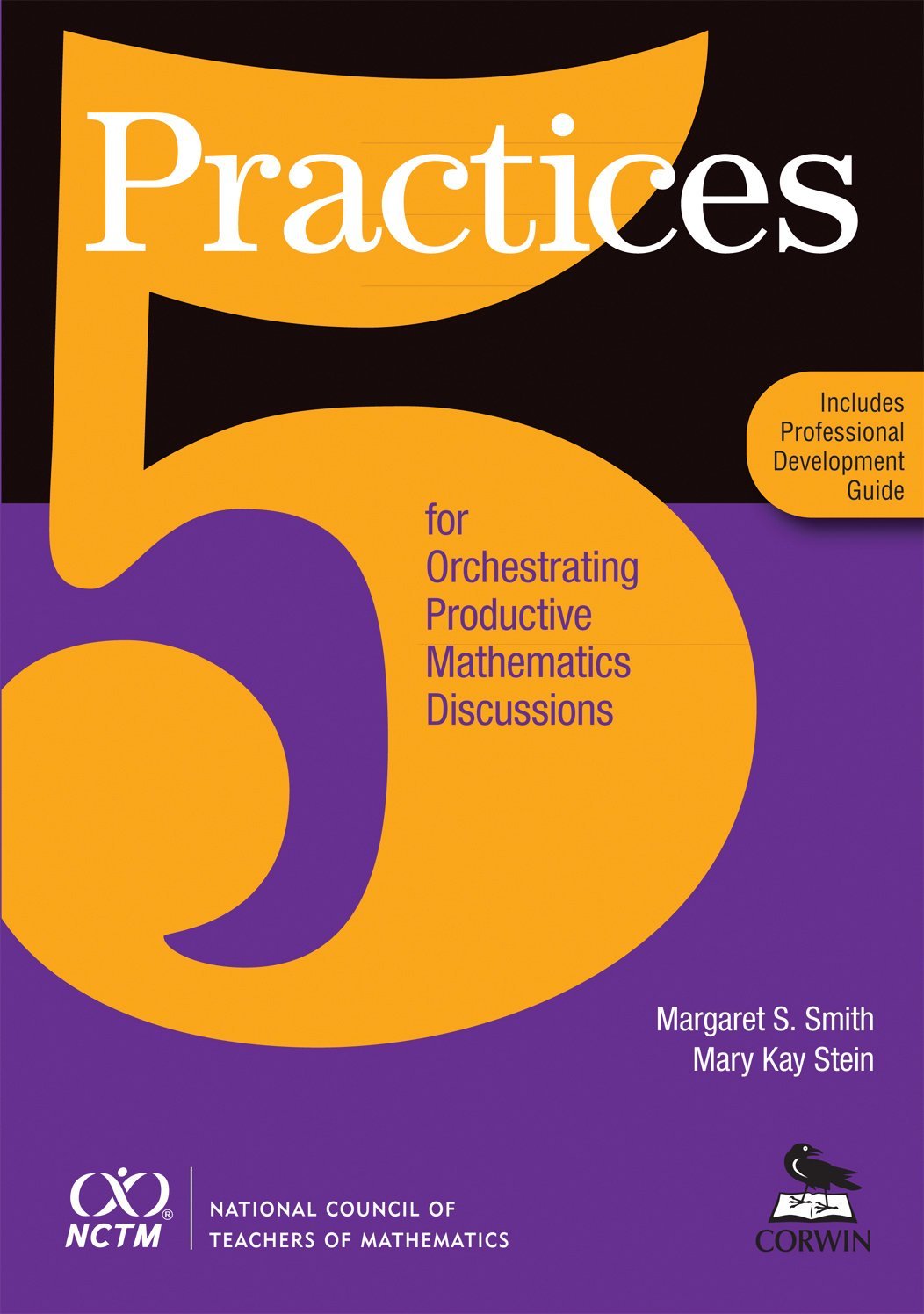
5 Practices for Orchestrating Productive Mathematics Discussions [NCTM]
$34.93
Related Products




Learn the 5 practices for facilitating effective inquiry-oriented classrooms
Anticipating what students will do–what strategies they will use–in solving a problem
Monitoring their work as they approach the problem in class
Selecting students whose strategies are worth discussing in class
Sequencing those students’ presentations to maximize their potential to increase students’ learning
Connecting the strategies and ideas in a way that helps students understand the mathematics learned
This book presents and discusses an framework for orchestrating mathematically productive discussions that are rooted in student thinking.
The 5 Practices framework identifies a set of instructional practices that will help teachers achieve high-demand learning objectives by using student work as the launching point for discussions in which important mathematical ideas are brought to the surface, contradictions are exposed, and understandings are developed or consolidated. By giving teachers a road map of things that they can do in advance and during whole-class discussions, these practices have the potential for helping teachers to more effectively orchestrate discussions that are responsive to both students and the discipline.
Includes a Professional Development Guide.
Publisher : National Council of Teachers of Mathematics
Publication date : April 15, 2011
Edition : First Edition
Language : English
Print length : 104 pages
ISBN-10 : 0873536770
ISBN-13 : 978-0873536776
Item Weight : 13.6 ounces
Dimensions : 10 x 0.31 x 7.09 inches
Best Sellers Rank: #915,139 in Books (See Top 100 in Books)
Customer Reviews: 4.6 4.6 out of 5 stars (99) var dpAcrHasRegisteredArcLinkClickAction; P.when(‘A’, ‘ready’).execute(function(A) { if (dpAcrHasRegisteredArcLinkClickAction !== true) { dpAcrHasRegisteredArcLinkClickAction = true; A.declarative( ‘acrLink-click-metrics’, ‘click’, { “allowLinkDefault”: true }, function (event) { if (window.ue) { ue.count(“acrLinkClickCount”, (ue.count(“acrLinkClickCount”) || 0) + 1); } } ); } }); P.when(‘A’, ‘cf’).execute(function(A) { A.declarative(‘acrStarsLink-click-metrics’, ‘click’, { “allowLinkDefault” : true }, function(event){ if(window.ue) { ue.count(“acrStarsLinkWithPopoverClickCount”, (ue.count(“acrStarsLinkWithPopoverClickCount”) || 0) + 1); } }); });
9 reviews for 5 Practices for Orchestrating Productive Mathematics Discussions [NCTM]
Add a review
![5 Practices for Orchestrating Productive Mathematics Discussions [NCTM]](https://momsmust-haves.com/wp-content/uploads/thumbs_dir/71gtZIklrkL._SL1496_-rkdbzkufvm641fgodwpyg65qskbdyxjz9wdubecrlg.jpg)
$34.93
Lance Bledsoe –
A great system that any math teacher can use
This well-written book will be useful for any math teacher looking for a way to move from superficial classroom discussions to ones that actually help students advance their understanding of mathematics. The authors do this by describing their Five Practices, and then demonstrating their usefulness by presenting five different classroom vignettes and pointing out how the Practices are (or could be) used to conduct good discussions.The Five Practices (Anticipating, Monitoring, Selecting, Sequencing, and Connecting) are intended to be used in lessons in which the students are working together in small groups to complete some mathematical task, and a class-wide discussion is expected to be the culminating event of the lesson. The Practices specifically identify the things that the teacher will be doing before the lesson (Anticipating), during the group work part (Monitoring, Selecting, and Sequencing), and during the discussion itself (Connecting).The authors open with a vignette of a teacher conducting a math lesson which ends with a class discussion, one which will look familiar to any math teacher. When I first read it I remember thinking that the teacher had done a pretty good job, but the authors then describe their Five Practices and point out some ways the lesson fell short, and I began to realize that there were a lot of things the teacher could have done much better.The authors then use the remaining vignettes to highlight specific things about each individual Practice, pointing out things that the individual teachers did well, how those things contributed to a productive discussion and increased mathematical understanding for their students, and how the reader can use the Five Practices in their own lessons.The book also includes several useful “study guide” type questions, what the authors call “Active Engagement” tasks, in which they recommend that the reader, for example, make notes about certain things while reading thru a particular vignette. I was initially somewhat dismissive of these, as I have seen them in other books and don’t generally find them all that helpful, but I found myself taking the authors up on these suggestions and it made the book an even more worthwhile read. At the end of the book, the authors include a “Professional Development Guide” with even more questions and suggestions for using the book to improve one’s teaching skills. The book also includes references to many journal articles which ground the Five Practices in research.The most valuable professional development activities I’ve been a part of have been the times I was able to sit in on another teacher’s classroom and just observe what they did. One of the things I really liked about this book was that it created that sense of actually sitting in a classroom and observing these different teachers conduct their lessons, only with an expert guide sitting right next to me pointing out different things to look for and giving me a road map to help me understand exactly what things the teacher is doing and why they are so useful for creating good discussions.If you are looking for a way to make your class discussions, and your student group work in general, more productive, I highly recommend this book.
C. Pettis –
So useful!
One of the most useful education-related books I have ever read. I always felt that the “share and summarize” portions of my lessons were the weakest part of my teaching repertoire and this book really helped me to see why AND gave me concrete tools that I am using to improve. Very easy to read and yet filled to the brim with the sorts of concrete suggestions that I find most useful. Truly transformational for me. I wish I could afford to give it to every teacher I know!
drock –
Good book
Had to buy it for a teacher class in college and decided to keep it for the future. Book will come in handy for being an effective math teacher.
Amparo –
A must read
I was introduced to this book thru a common core professional development thru my school district. As a novice with the expectations of what common core entails, I ordered this resourceful book. This book helps any educator understand how you can take a closer look at your math standards and present them to your students in a conceptual matter. This book helps you learn how to facilitate your math lessons easier. It is a friendly teacher read. you will feel excited and read to apply the five practices into your classroom. The five practices, demonstrate guarantee success in your classroom. can’t wait to apply them this school year.
ratzelster –
Excellent application to math class
So often the math books you buy don’t really help you change and think differently. This book is solid on the math and extremely helpful on deepening the way I think about preparing for class. I have been able to improve the quality of my class discussions using techniques that I learned from reading this book.
Robert McGregor –
A great read
I had heard about complex instruction in the Maths classroom after reading ‘The Elephant in the Classroom’ by Jo Boaler. Until I read this book I had not been able successful in finding a book that would give me step by step guidance in this form of instruction. Recommended for any teacher wanting to introduce collaborative learning in the Maths classroom.
J. Spencer –
Finally a how book on math discussions!
Finally, a really good book on leading a math lesson like an ELA lesson for math teachers. The only thing that would make this better would be case studies of a few teachers classrooms and their planning process. Really helpful to break it down for this veteran teacher!
Carlos A. Rodriguez –
Looking Forward to Implementing
Bought this book because of training I went to and it was highly recommended. Remember there is nothing new in this book that we do not already do as veteran teachers, is just displayed in an organized way to help new teachers get it right quicker.
DaRhino –
This book is very practical and helpful when coming up with authentic applications based on “real-world” problems.